
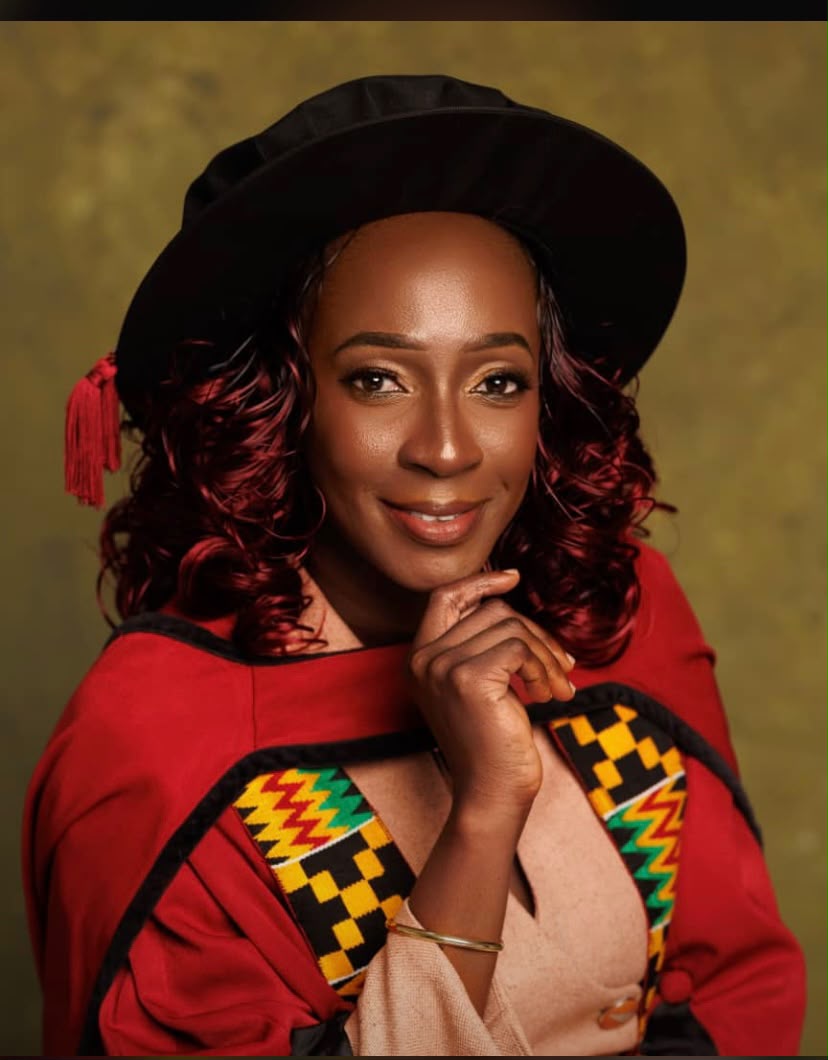

For Dr. Dziedzorm Abra Adzam, the decision to pursue Migration Studies was driven by a question that connected her professional background in clinical psychology with a growing interest in human mobility: where does psychology fit within the migration space?
As a clinical psychologist, Dr. Adzam had long been interested in understanding the emotional and psychological experiences of individuals facing difficult life circumstances. When she encountered Migration Studies, she saw an opportunity to expand her understanding of how migration, displacement and adaptation shape people’s mental well-being.
“I wanted to better understand the emotional and psychological experiences of people who migrate, the challenges they face, how they cope with displacement and cultural adjustment, and what helps them build resilience,” she said.
That curiosity led her to pursue a PhD in Migration Studies at the University of Ghana’s Centre for Migration Studies (CMS), where she graduated in 2026 after enrolling in the programme in 2021.
Her doctoral research, titled “Mental Health of Female Victims of Trafficking: A Qualitative Study,” examined the psychological experiences of women who have been trafficked and the mental health challenges they encounter at different stages of their migration journeys.
The study explored the impact of trafficking on survivors, including experiences of trauma, fear, loss and resilience, while highlighting the importance of trauma-informed and survivor-centred approaches in supporting victims.
For Dr. Adzam, the research provided an opportunity to bridge her expertise in clinical psychology with migration scholarship.
“My research allowed me to connect my background in clinical psychology with the realities of migration and deepened my appreciation of the need for effective mental health support for migrant populations,” she said.
She describes her experience studying Migration Studies at CMS as challenging, insightful and enriching, noting that the programme expanded her understanding of migration beyond a single disciplinary perspective.
“The programme pushed me to think beyond my usual clinical perspective and consider migration through broader social, cultural and policy lenses,” she said.
Through the programme, Dr. Adzam developed a deeper appreciation of migration as a complex phenomenon shaped by psychological, social, economic, political, legal and cultural factors.
She said one of the most valuable lessons from the programme was the importance of interdisciplinary thinking.
“Rather than viewing migration through a single lens, I learned to consider its different dimensions and develop more balanced, evidence-based perspectives on migration challenges and opportunities,” she said.
Her doctoral journey was also shaped by opportunities for research collaboration and engagement beyond the classroom. As a beneficiary of the IDRC Research Chair on Forced Displacement in Anglophone West Africa, the Africa Centre for the Study and Research on Migration, and the Cluster of Research Excellence (CoRE) in Migration and Health collaborative workshops for PhD students and early-career researchers, Dr. Adzam gained exposure to wider scholarly conversations on forced displacement and migration-health research.
She said these platforms provided valuable opportunities to engage with researchers from diverse backgrounds, strengthen her research skills and connect her work to broader conversations on migration and health.
“The workshops created spaces where I could learn from other researchers, exchange ideas and appreciate the importance of collaboration in addressing complex migration challenges,” she said.
Dr. Adzam expressed gratitude to the IDRC Research Chair on Forced Displacement in Anglophone West Africa and its Chair, Prof. Mary B. Setrana, for the support, mentorship and opportunities provided throughout her research journey.
She also acknowledged the guidance of her doctoral supervisors—Prof. Kwaku Oppong Asante, Prof. Angela Anarfi Gyasi-Gyamerah and Prof. David L. Sam—for their patience, encouragement and support.
“My supervisors were truly God-sent. They went beyond academic supervision and genuinely cared about my well-being and success throughout the journey,” she said.
She also appreciated the wider academic community at CMS for creating a supportive environment where students felt valued and encouraged.
Dr. Adzam hopes to continue exploring the role of psychology in migration research and contribute to interdisciplinary approaches that improve policies and interventions for migrant populations.
She encourages professionals and prospective students from diverse backgrounds to consider Migration Studies, describing it as a programme that provides a unique opportunity to connect different areas of expertise with migration issues.
“The interdisciplinary nature of the programme is one of its greatest strengths. It brings together people from diverse backgrounds and creates a learning environment where everyone has something valuable to contribute,” she said.
For Dr. Adzam, her journey through Migration Studies has reinforced a key lesson: understanding migration requires looking beyond movement itself and paying attention to the human experiences, vulnerabilities and resilience that shape every migration story.
- Log in to post comments